
Makhana (fox nuts) has graduated from a regional Indian snack to a globally noticed superfood. Rising health awareness, clean-label demand, and improved processing are driving rapid change in the category. This article summarizes the latest data, forecasts, and actionable trends shaping the future of makhana.
Quick snapshot — market size & growth (what the numbers say)
- India market snapshot: Recent industry estimates place the India makhana market in the early 2020s at several hundred crores INR with strong projected growth through the next decade; one market study values the India market at INR 9.29 billion (2025) and forecasts it reaching INR 19.95 billion by 2034 (CAGR ≈ 8.8%).
- Global market: Global fox-nuts market reports estimate a mid-to-high single-digit CAGR for the coming decade; conservative projections put 2026–2035 growth around 8–9% CAGR with global market size doubling or more by 2034.
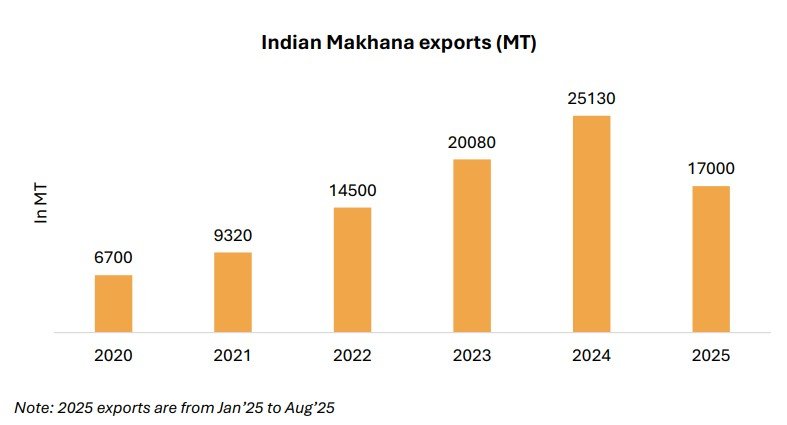
- Export surge: Official trade dashboards and export studies show dramatic export expansion — Indian makhana exports rose from roughly 6,700 MT in 2020 to about 25,130 MT in 2024 (≈39% CAGR), driven by demand from the US, UAE and Canada and better processing and certification.
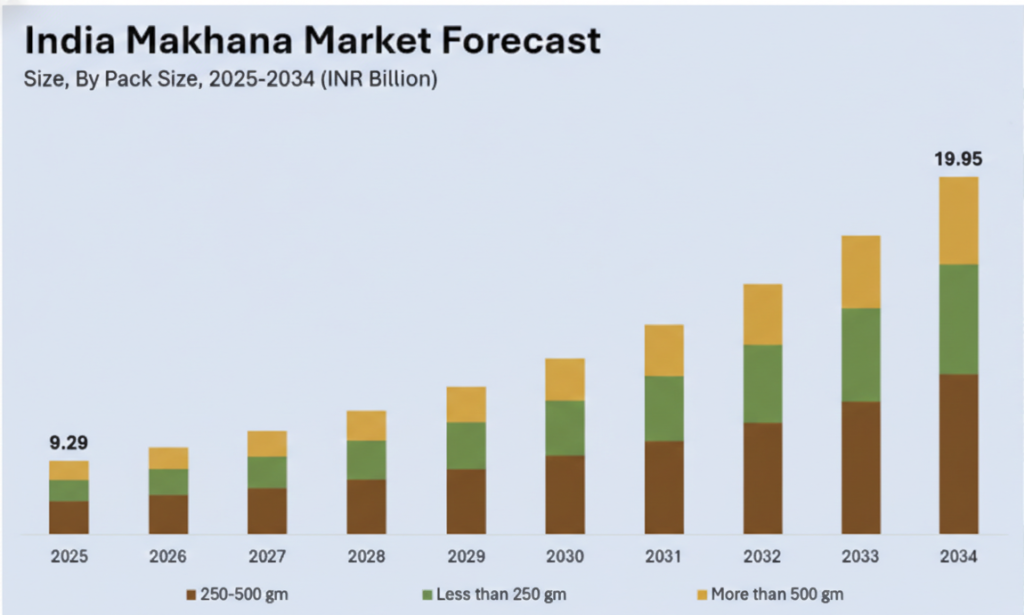
Takeaway: both domestic premium demand (organic, clean label, RTE snacks) and export demand are strong growth engines.
https://www.imarcgroup.com/india-makhana-market
Where it’s grown: production geography and supply dynamics
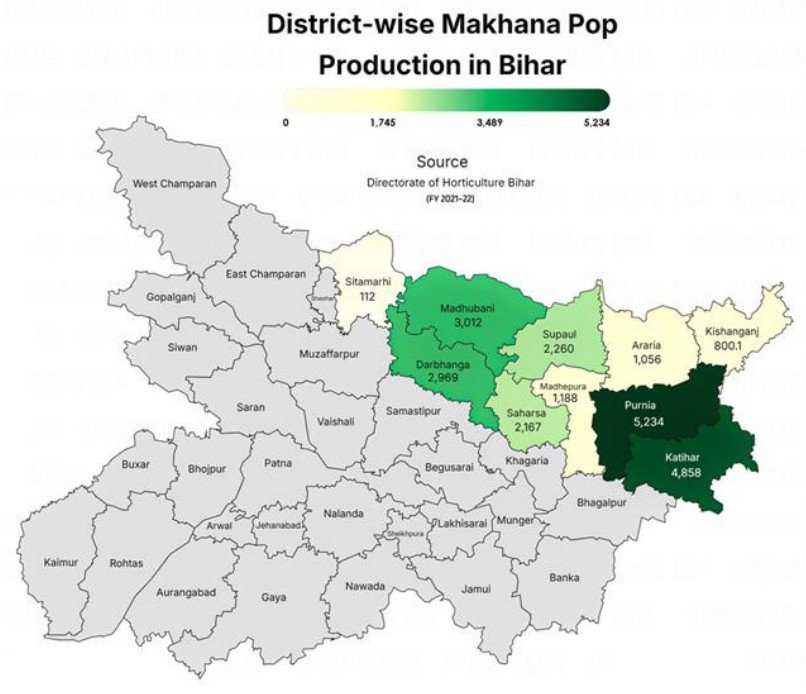
India remains the dominant global producer. The state of Bihar accounts for the lion’s share of cultivation (estimates commonly cite ~80–90% of national output), concentrated in traditional Mithila/Kosi wetland systems. National and state studies show area expansion, targeted varietal releases, and year-round cultivation pilots increasing supply and quality in northern Bihar.
Implication: any strategy for scale — private label, exports, or branded retail — must secure reliable sourcing in Bihar through farmer partnerships, contract farming, or direct procurement.
Key demand drivers shaping the next 5–10 years
- Health & clean-label momentum. Consumers are searching for plant-based, gluten-free, and low-calorie snacks — all strengths for makhana. The organic/clean-label snack segment in India is growing rapidly (organic snack market valuations and forecasts show double-digit growth in some reports).
- Export market diversification. As processing and grading improve, higher-grade (>18 mm) makhana fetch premium prices internationally. Export volumes and values have already increased substantially.
- Value-added product innovation. Roasted & flavored makhana, protein-blends, meal-toppers, and fortified formats will widen use cases beyond snacking into breakfast, trail mixes, and premium gifting.
- Food-safety & certification demands. Buyers increasingly require HACCP, FSSAI export standards, and organic certification — pushing companies to invest in traceability and GMP lines.
- Mechanization & varietal improvement. High-yield, high-popping varieties and mechanized roasting/grading reduce cost and improve consistency — an essential step to meet large retail and export contracts. Recent agricultural initiatives are releasing high-yield varieties to help this transition.
Production & technology trends — how supply will evolve
- Varietal gains: Agricultural research institutions are releasing varieties with higher popping percentages, larger seed size, and better yield per hectare. These reduce raw-material risk and raise exportable grade volumes.
- Mechanized processing: Automated tempering, controlled popping/roasting chambers, and mechanical graders are lowering labour bottlenecks and increasing batch consistency. Processed makhana with consistent whiteness and low moisture is essential for shelf life and export specs.
- Cold-chain & moisture control: Better storage and humidity-controlled warehousing cut aflatoxin and mould risks and extend merchantability windows for bulk shipments.
- Digital traceability: QR-linked lot IDs and farm-level traceability will become table stakes for premium exports and private-label buyers.
Pricing & margins — what to expect
- Premium, organic, and flavored variants command significantly higher per-kg prices than raw commodity makhana.
- Investment in processing (mechanization, certification) raises CapEx but reduces Opex per kg at scale, improving margins for organized players.
- Export premiums for larger grain sizes and certified organic lots can be substantial; grading and consistent QA are therefore highly profitable investments.
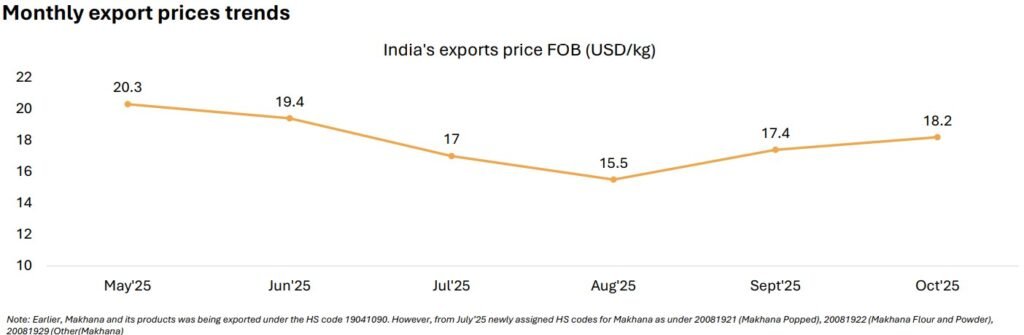
https://apeda.gov.in/sites/default/files/2025-10/MIC_Monthly_dashboard_Makhana_30102025.pdf
Risks & constraints to monitor
- Seasonality & climatic risk: pond ecology and monsoon patterns affect yields and timing.
- Certification lead times: organic/GAP certifications require time and audits; building certified supply chains is a medium-term play.
- Price volatility: as new processors scale, short-term oversupply could pressure farmgate prices unless demand keeps up.
- Infrastructure gaps: rural electrification, storage, and logistics must improve to reliably scale exports.
Actionable recommendations (for processors, exporters & farmers)
For processors & brands
- Invest in controlled roasting chambers, grading lines, and moisture-controlled packaging.
- Secure long-term farming contracts or farmer producer organization (FPO) partnerships in Bihar.
- Obtain HACCP, FSSAI export compliances and pursue organic certification for targeted SKUs.
- Launch a D2C pilot for flavored RTE makhana to validate premium pricing and positioning.
For exporters
- Target markets: USA, UAE, Canada and UK initially; prioritize buyers searching for organic and specialty snacks.
- Build SKU tiers: commodity raw, premium graded (>18 mm), and value-added flavored/organic packs.
- Use batch-level traceability to reduce buyer friction and claims.
For farmers & FPOs
- Evaluate adopting improved varieties and coordinated drying/storage to increase popping percentage and reduce post-harvest loss.
- Form or join FPOs to access better bargaining power and collective certification routes.
Q1: Is makhana a good export product for 2026–2030?
A1: Yes — exports have shown very high growth (2020→2024), with demand from US, UAE and Canada. Higher-grade and organic lots are particularly attractive.
Q2: Which region is best to source makhana?
A2: Bihar remains the primary production hub (≈80–90% of Indian output), especially the Mithila/Kosi wetlands. Securing procurement here is critical for scale.
Q3: What investments improve export readiness?
A3: Grading equipment, controlled roasting, HACCP/FSSAI compliance, moisture-proof packaging, and organic certification.