For distributors, wholesalers & corporate gifting buyers | 15min read
Flip over any snack packet in a supermarket right now. Read the ingredient list — the full one, not just the front-of-pack claim. Count how many ingredients you can actually picture as food.
If you get past seven or eight and still can’t place half of them, that packet is not clean label. It might say ‘natural’. It might have a green leaf on it. It might cost more than the regular option on the shelf. But it isn’t clean.
That distinction — between looking healthy and being honest about what’s inside — is exactly what the clean label movement is about. And it’s gaining ground in India faster than most food brands were prepared for.
What Does ‘Clean Label’ Actually Mean?
There’s no official definition. No FSSAI stamp that says ‘clean label approved’. No checkbox, no certification body. The term came from consumers, not regulators — from shoppers who started reading labels more carefully and didn’t like what they found.
In practice, a clean label product is one that:
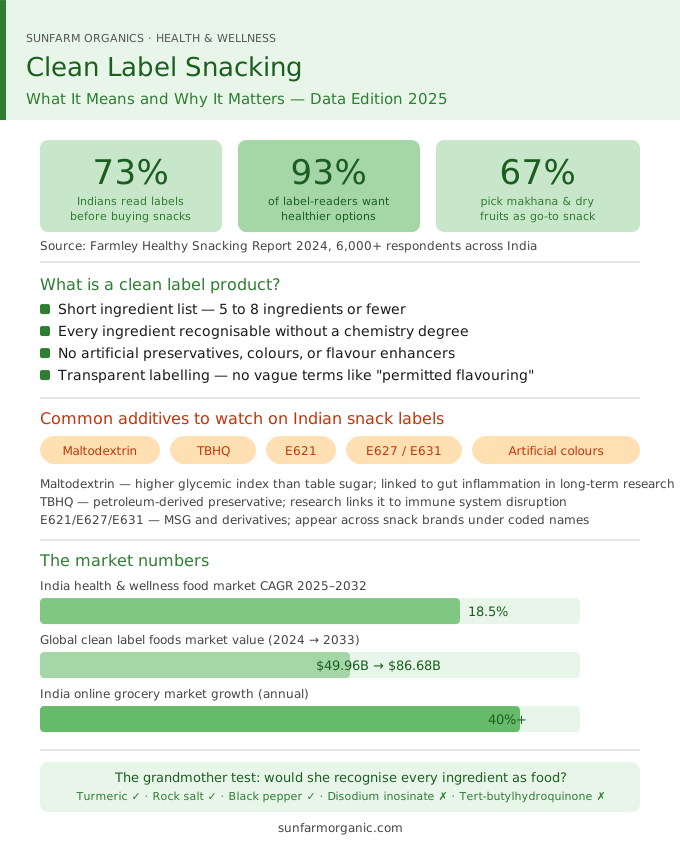
- Has a short ingredient list — typically five to eight ingredients or fewer
- Uses ingredients that are recognisable without a chemistry background
- Contains no artificial preservatives, colours, or flavour enhancers
- Avoids processing aids with coded names like E-numbers where natural alternatives exist
- Is transparent about what’s in it — no vague terms like ‘permitted flavouring’ or ‘edible starch’
That’s it. No exotic requirement. Just honesty about what’s in the bag.
“Clean label is not a scientific term — it is a consumer term. It means making a product using as few ingredients as possible, and making sure those ingredients are natural.” — Straits Research, 2025
The Numbers Behind the Shift
This isn’t a niche concern anymore. Here’s what the data actually shows about where India’s food market is heading.
₹7.4L Cr+ India’s healthy food market size in 2024 (Market Research Future)
18.5% CAGR of India’s health & wellness food segment, 2025–2032 (DataBridge Market Research)
73% of Indians surveyed read ingredient lists before buying snacks (Farmley Healthy Snacking Report 2024, 6,000+ respondents)
93% of label-readers said they want to switch to healthier options (same report)
67% of Indian consumers chose makhana and dry fruits as their go-to snack (Healthy Snacking Report 2024)
94.2% of Indian food experts in 2024 predicted consumers would cut back on ultra-processed foods (Godrej Food Trends Report 2024)
The clean label foods market globally was valued at USD 49.96 billion in 2024 and is projected to reach USD 86.68 billion by 2033, growing at 6.3% annually. Asia Pacific — where India sits — held the largest market share in 2024 as manufacturers shifted focus away from saturated Western markets.
Put simply: the consumer has moved. Brands are now catching up.
What’s Actually in Most Packaged Snacks
This is the uncomfortable part. A lot of snacks that are marketed as healthy — or at least positioned as ‘better for you’ — carry ingredient lists that tell a different story. Here are the most common ones worth knowing about.
| Additive | What It Does | Why It’s Used | The Concern |
| Maltodextrin | Thickener, filler, texture agent | Cheap bulking agent, extends shelf life | GI higher than table sugar; linked to gut inflammation in long-term studies (Laudisi et al., 2019; Frontiers in Immunology, 2022) |
| TBHQ | Petroleum-derived preservative | Extends shelf life in oils and fried snacks | Research links it to immune system disruption and increased food allergy susceptibility (Ann Shippy MD, 2025) |
| E621 (MSG) | Flavour enhancer | Creates addictive umami taste cheaply | Linked to headaches, nausea, and skin reactions in sensitive individuals; banned in baby food across most countries |
| E627 / E631 | Flavour enhancers (MSG derivatives) | Amplify MSG effects at lower cost | Often appear together in snacks to create MSG-like effects without listing MSG directly |
| Acidity Regulators 330/331 | pH control, preservative function | Maintains product consistency | Citric acid derivatives — generally mild but signal heavy processing |
| Partially Hydrogenated Palm Oil | Texture, shelf stability | Cheap fat source in budget snacks | Trans fat source; linked to cardiovascular risk; EU has banned trans fats in food |
| Artificial Colours (E102, E110, E129) | Visual appeal | Makes snacks look more vibrant | Several linked to hyperactivity in children; banned or restricted in UK and EU |
None of these will cause a problem in a single serving. That’s usually how their safety approvals are framed — ‘safe within acceptable daily limits’. But those limits assume you’re eating one type of processed snack occasionally, not multiple processed foods daily across months and years. Which is exactly how most people actually eat.
A 2024 systematic review found that higher consumption of ultra-processed foods is associated with greater risk of cardiometabolic disease and mortality. The review was published in a leading medical journal — not a wellness blog.
How to Read a Label in 60 Seconds
You don’t need to memorise a chemistry textbook. A few quick checks will tell you most of what you need to know.
1. Count the Ingredients
Five or fewer is generally a good sign. Ten or more is worth a closer look. Over fifteen, and you’re almost certainly looking at a highly processed product regardless of what the front of the pack says.
2. Look for the Triggers
| If you see this… | It means… |
| ‘Edible starch’ or ‘modified starch’ | Usually maltodextrin or a similar filler — processed carbohydrate with no nutritional value |
| ‘Permitted flavouring’ or ‘artificial flavour’ | The brand doesn’t have to tell you what’s actually in it |
| Sugar listed as 3+ different names | Brands split sugar into sucrose, glucose syrup, maltose etc. to push it down the ingredients list |
| E-numbers in the 600s (E621, E627, E631) | MSG or MSG derivatives — flavour enhancers that create addictive taste loops |
| ‘Vegetable oil’ without specifying which | Usually palm oil — the cheapest available and often partially hydrogenated |
| ‘Acidity regulator’ listed without a name | Often citric acid — mild, but signals the product is heavily processed enough to need pH control |
3. The Grandmother Test
This is the simplest filter: would your grandmother recognise every ingredient on that list as food? Turmeric — yes. Rock salt — yes. Black pepper — yes. Disodium inosinate — no. Tert-butylhydroquinone — definitely not.
It’s not a perfect test. But it gets you 80% of the way there without any research.
Why Makhana Is a Clean Label Snack by Nature
Makhana — fox nuts — was eaten in India for centuries before anyone needed a ‘clean label’ movement to justify it. It’s a pond-grown crop, minimally processed, naturally low in saturated fat, and reasonably high in protein compared to most grain-based snacks.
Here’s what the nutritional profile of plain roasted makhana actually looks like per 30g serving:
| Nutrient | Per 30g Serving | Vs Regular Fried Chips (30g) |
| Calories | ~107 kcal | ~160 kcal |
| Total Fat | ~0.5g | ~10g |
| Saturated Fat | ~0.1g | ~1.5–3g |
| Protein | ~3.5–4g | ~2g |
| Carbohydrates | ~20g | ~15g |
| Fibre | ~0.5g | ~1g |
| Sodium | ~1mg (plain) | ~150–300mg |
The raw ingredient barely needs anything added. A good roasted makhana snack should have four to six ingredients — the fox nut itself, a light oil for roasting, salt, and whatever spice blend the flavour calls for. Black pepper, turmeric, chilli, ajwain — all real, all recognisable.
This is what makes makhana such a natural fit for clean label positioning. You’re not reformulating around a problem. The ingredient itself is already clean. You just have to not ruin it.
59% of Millennials and 47% of Gen X consumers reached for makhana as a snack choice, according to the Farmley Healthy Snacking Report 2024. The category’s appeal is broader than most brands assumed.
Why This Matters Right Now — Not in Five Years
The timing question is worth taking seriously. Clean label has been a conversation in Western markets for a decade. India is about five to seven years behind that curve — which sounds like there’s room to wait. There isn’t, for a few reasons.
Quick Commerce Changed Everything
When you buy a snack from a physical shelf, the front-of-pack does most of the selling. You pick it up, you see the branding, you buy it. On Blinkit, Zepto, or Instamart, the product listing includes ingredients. The customer is sitting on their couch with time to scroll. Returns are easy. Reviews are public. Negative ingredient reactions get posted. The environment that let opaque labels slide in retail doesn’t exist in quick commerce the same way.
India’s $12 Billion Online Grocery Market Is Growing 40%+ Per Year
According to USDA analysis of India’s food retail sector, online grocery is growing over 40% annually. The consumers driving that growth — urban millennials and Gen Z — are the exact demographic that reads labels and shares what they find. This isn’t a future concern. It’s the current operating environment for any brand selling online.
Food Adulteration Has Made People More Suspicious, Not Less
The wave of food adulteration cases that made headlines in 2023 and 2024 — across spices, confectionery, and packaged goods — changed how a significant section of consumers approaches any packaged product. According to the Farmley survey, the heightened scrutiny of labels is directly linked to this. Trust is harder to earn now. A complicated ingredient list reads, fairly or not, as something to hide.
Non-GMO Preference Is Already Majority Behaviour
In India’s health and wellness food market, the Non-GMO segment held a 67.5% revenue share in 2024. Purchasing decisions — particularly in metro and Tier 1 cities — are already being filtered through an ingredient lens. This isn’t a fringe position.
What to Actually Do With This
If you’re reading this because you want to snack better — or buy better — here are a few practical habits that don’t require reading a nutrition science textbook.
- Read the ingredient list first, not the front of pack. The front is marketing. The back is disclosure.
- Use the five-ingredient check as a rough filter. It won’t catch everything, but it catches most of it.
- Be sceptical of ‘natural flavour’. Under current FSSAI labelling rules, this phrase covers a wide range of processed compounds that may be derived from natural sources but are far from whole food.
- Compare two similar products side by side. Once you start doing this, the difference becomes obvious very fast.
- Don’t assume price equals cleanliness. Some premium-priced snacks have just as many additives as the budget version — they just have nicer packaging.
- Look at where oil comes from. ‘Sunflower oil’ or ‘cold-pressed groundnut oil’ is more transparent than ‘vegetable oil’.
- Treat the 58% cost barrier honestly. If clean label snacks cost more, it’s usually because real ingredients cost more to source and process. That’s a real trade-off, not a brand excuse.
Over 58% of survey respondents said cost is the main barrier to switching to healthier snacks. This is a genuine friction point — and it won’t go away by being ignored. But for the 42% who are already buying, or trying to buy, cleaner options — the market is real and growing.
A Note on What We Do
At Sunfarm Organics, every makhana SKU we develop starts with a constraint: the ingredient list has to be short enough to read in ten seconds, and every item on it has to be something you’d find in a kitchen — not a manufacturing plant.
That means no maltodextrin as a carrier. No E621 to amplify flavour on the cheap. No vague ‘permitted flavouring’. When we develop a new flavour, the spice blend is real — sourced from identifiable suppliers, used in quantities you’d actually taste, not just enough to list on the label.
We know this makes some things harder. It narrows the flavour options that work at scale. It limits the shelf life versus a product with multiple preservatives. But it also means the product matches what the label says — and increasingly, that’s the difference between a brand customers stay with and one they move on from after the first purchase.
Try Sunfarm Organics makhana at sopure.in
Sources & Data References
- Market Research Future — India Healthy Food Market Report, 2025
- DataBridge Market Research — India Health & Wellness Food Market, 2024
- Farmley Healthy Snacking Report 2024 — Survey of 6,000+ consumers across India
- Godrej Food Trends Report 2024 — 90.4% and 94.2% expert predictions cited
- Straits Research — Clean Label Foods Market Report, 2025
- USDA GAIN Report: India Retail Foods Annual, 2025 — Online grocery growth figure
- Laudisi et al., 2019 — Maltodextrin and intestinal inflammation (animal study, long-term exposure)
- Zangara et al., Frontiers in Immunology, 2022 — Maltodextrin and intestinal mucus barrier
- Ann Shippy MD, 2025 — TBHQ immune system effects summary
- Business Standard / Daily Pioneer — Farmley Healthy Snacking Report coverage, July 2024
- Food Navigator Asia — Makhana snack trends data, August 2024